
CNC machining and 3D printing are the two most important digital manufacturing technologies for producing functional parts from digital files, but they operate on fundamentally different principles. CNC machining is a subtractive process that removes material from a solid block using cutting tools, while 3D printing is an additive process that builds parts layer by layer from powder, filament, or resin. The choice between the two technologies depends on the part geometry complexity, the material requirements, the production quantity, the tolerance demands, and the surface finish requirements. Understanding the strengths and limitations of each process allows product teams to select the optimal manufacturing strategy for each part, and increasingly, to combine both technologies in hybrid manufacturing approaches that leverage the advantages of each process for different features of the same part.
CNC machining offers superior material properties compared to 3D printed parts because the material starts as a wrought or extruded stock with consistent mechanical properties throughout the cross section. The cutting process does not introduce the layer interfaces that create anisotropy in 3D printed parts, where the Z-axis strength is typically 50 to 80 percent of the X-axis strength depending on the printing technology and material. CNC machined metal parts have isotropic mechanical properties with no internal voids or porosity, making them suitable for load-bearing applications where failure could cause injury or equipment damage. The surface finish of CNC machined parts is also superior, with Ra values of 16 to 63 microinches achievable in standard production, compared to 125 to 500 microinches for most 3D printing processes without post-processing. The dimensional accuracy of CNC machining at plus or minus 0.001 to 0.005 inches is typically 5 to 10 times better than 3D printing at plus or minus 0.005 to 0.020 inches for standard machine settings. For cnc machining parts that require mechanical strength, tight tolerances, or smooth surface finishes, the subtractive process remains the standard because the material structure and production precision cannot yet be matched by additive processes.
3D printing excels at geometric complexity that would be expensive or impossible to machine. Internal cooling channels in injection mold inserts, lattice structures for lightweight components, organic shapes for medical implants, and one-piece assemblies with moving parts that would require multiple CNC setups and assembly operations are all examples of geometries that favor additive manufacturing. The design freedom of 3D printing allows the part geometry to be optimized for function rather than constrained by manufacturing limitations. The cost of complexity in 3D printing is essentially zero because the build time and material consumption are determined by the part volume and height rather than the geometric complexity. In CNC machining, each additional feature adds programming time, tool changes, and machining time, so complex parts cost more than simple parts. The break-even analysis between CNC machining and 3D printing for metal parts typically falls at a complexity threshold where the part has features requiring five or more setups on a CNC machine, or internal features that cannot be produced by machining at all.
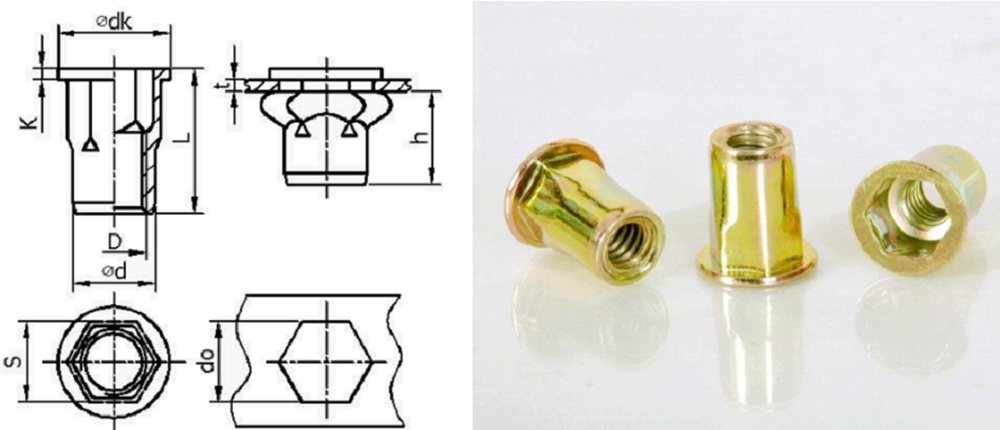
The quantity threshold where CNC machining becomes more economical than 3D printing depends on the part size, material, and complexity, but for most metal parts the crossover is between 10 and 100 units. Below 10 units, the setup cost of CNC machining is spread across too few parts, making 3D printing or manual machining more economical. Between 10 and 100 units, the CNC process becomes competitive because the per-part cycle time is much faster than the build time for 3D printing, and the setup cost is amortized across enough parts. Above 100 units, CNC machining is typically the clear winner for metal parts because the linear cost scaling and fast cycle times produce lower total cost than the additive process that builds each part individually. The m8 rivet nut hole size specifications in CNC machined parts highlight an important distinction—threaded features are always stronger in machined parts than in 3D printed parts because the cutting tool forms the thread in solid material rather than building it in layers that can separate under tensile load.
- Choose CNC machining when you need isotropic mechanical properties, tight tolerances below 0.005 inches, smooth surface finish below Ra 125, production quantities above 100 units, or materials that are not available in printable grades
- Choose 3D printing when your part has complex internal features, organic shapes, lattice structures, or quantities below 10 units where the CNC setup cost cannot be justified
- Hybrid manufacturing uses 3D printing for near-net-shape preforms that are then finished by CNC machining to achieve the required tolerances and surface finish, combining the geometric freedom of additive with the precision of subtractive in a single process flow
The material selection for each process also differs significantly. CNC machining can process virtually every engineering material including aluminum, steel, stainless steel, titanium, brass, copper, plastics, and composites, with the material properties matching the wrought or extruded standard. Metal 3D printing is limited to a subset of weldable alloys including titanium Ti-6Al-4V, stainless 17-4 PH and 316L, aluminum AlSi10Mg, and Inconel 718 and 625, with the printed material properties requiring heat treatment to match the machined equivalent. The feedstock cost for metal 3D printing powder ranges from 100 to 500 dollars per kilogram compared to 5 to 50 dollars per kilogram for CNC stock materials, and the material utilization in 3D printing is typically 10 to 30 percent because the unsintered powder must be recycled and reused with diminishing quality. The custom cnc parts buyer considering the additive versus subtractive decision should request quotes for both processes on their specific part geometry, because the unique geometry of each part shifts the cost crossover point in ways that general rules cannot capture.